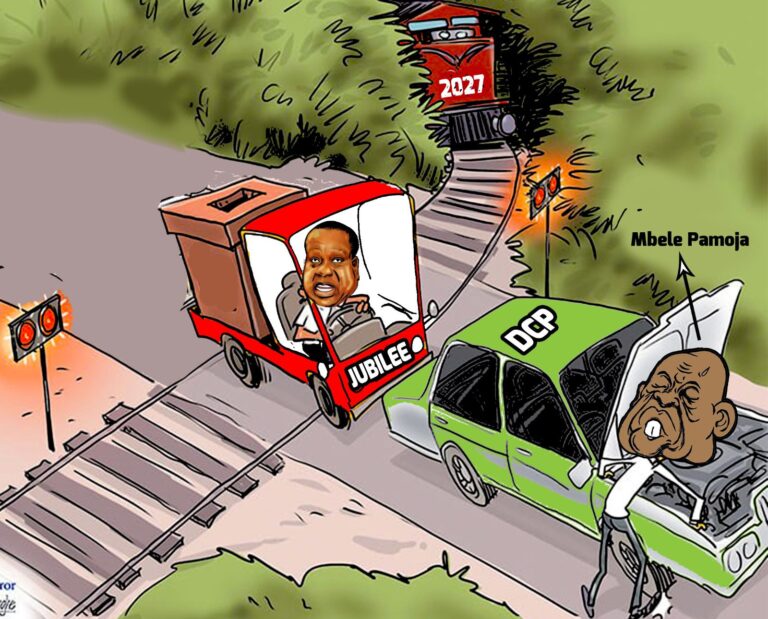
Today, Kamukunji MP Yusuf Hassan formally left the Jubilee Party and joined Rigathi Gachagua’s Democracy for Citizens Party. He was welcomed at DCP headquarters, pledged to seek a third term on a DCP ticket, and declared support for Gachagua’s 2027 presidential ambitions. This is not an isolated defection. It is the latest chapter in a familiar strategy.
In 2022, Gachagua was one of the loudest voices urging Mt Kenya leaders to abandon Jubilee and join UDA. The argument then was that the region needed a single vehicle to deliver victory. The result was the near collapse of Jubilee’s structures in the mountain and the elevation of a new power centre. Today, the same Gachagua is repeating the script this time against Jubilee, and increasingly against any party that does not submit to DCP.
The danger is not merely that one party gains at the expense of another. The deeper problem is what this method does to the quality of leadership and the nature of political competition.
When a dominant figure systematically weakens other parties in a region, aspirants begin to calculate differently.
The safest path to a ticket and to victory becomes proximity to the kingpin rather than a coherent agenda, a clear manifesto, or proven service to constituents. Candidates spend more energy seeking the blessing of one man than articulating what they will do for the people who elect them. Over time, this lowers the bar. Parties stop functioning as vehicles for ideas and become mere labels attached to personal networks.
Gachagua presents these defections as expansion and inclusion.
In reality, they continue a pattern of political centralisation: one residence as the centre of consultations, one party as the preferred vehicle, and growing pressure on other outfits to either fold or become irrelevant in Mt Kenya and parts of Nairobi. The same approach that helped dismantle Jubilee’s regional dominance in 2022 is now being applied to whatever remains of organised alternatives.
Kenya’s democracy does not benefit when one politician’s project systematically hollows out other parties. Strong parties force candidates to develop platforms, defend records, and compete on ideas. Weak, subordinate parties produce dependent politicians who answer first to the centre and only secondarily to the voter.
Yusuf Hassan’s move is his democratic right. The broader strategy it serves is not. A politics that prioritises the accumulation of tickets and loyalty over the cultivation of competing programmes and accountable leaders is not building a stronger opposition. It is building a narrower one and the cost will be paid in the quality of representation Kenyans receive.
About the Author