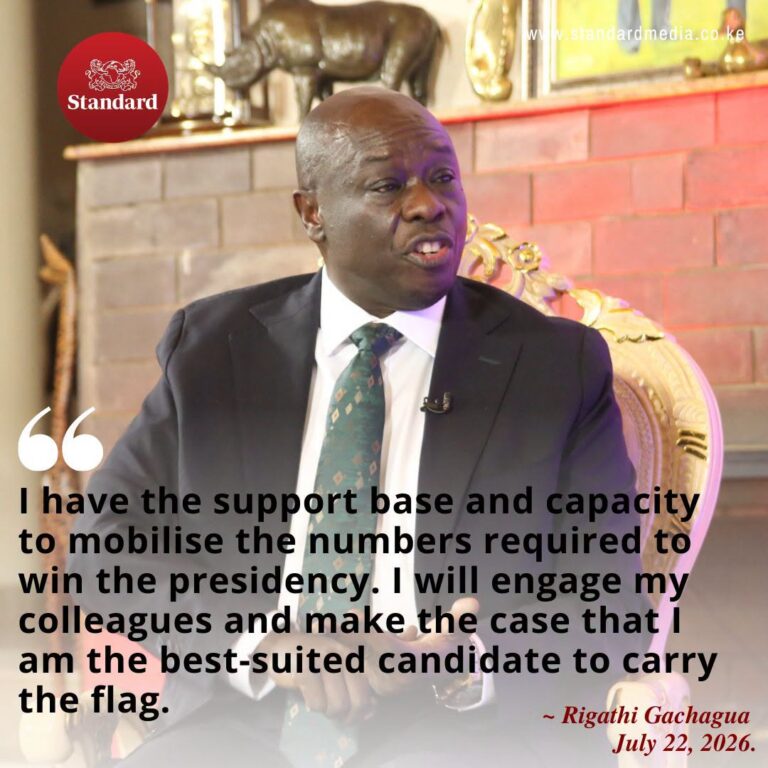
Can we trust Rigathi Gachagua? His actions — both in and out of office — raise serious questions about integrity, consistency, and motive.
After his impeachment, Gachagua suddenly rebranded himself as an anti-corruption crusader, claiming he would “clean up” the system. But the facts tell a very different story.
He personally benefited from the withdrawal of a KES 7.4 billion graft case against him — a case that had already gone through extensive investigations. Shortly after, he regained KES 200 million that had previously been seized by the court on suspicion of corruption. And now, questions linger around his sons’ alleged involvement in the Kemsa scandal, a reminder that the old habits of political families die hard.
Before his fall from power, Gachagua was not a symbol of justice or reform — he was an enforcer. He harassed businesspeople from Mt. Kenya who dared to support former President Uhuru Kenyatta, influenced the cancellation of contracts for officials appointed during Uhuru’s administration, and suppressed emerging voices within the region who threatened to outshine him politically.
His brand of politics thrived on intimidation and fear. He even ordered the arrest of Mt. Kenya youth and elderly women who attended prayer meetings in Nyeri and Murang’a — simply because they didn’t support his side of the divide.
So today, when he parades himself as a champion of the oppressed, we must ask: What exactly changed — his heart or his circumstances?
Rigathi Gachagua’s so-called movement under DCP is nothing but a green wheelbarrow — noisy, empty, and constantly rolling in circles.
The truth is simple: a man who once silenced his own people cannot be trusted to speak for them today.
About the Author