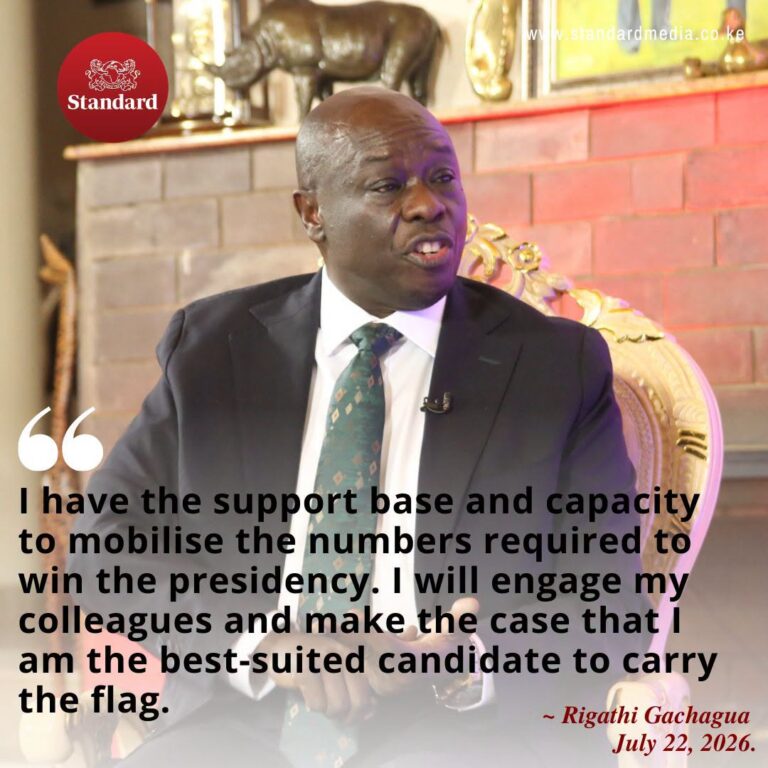
Kenya is basking in an unfamiliar calm, a fleeting respite from the divisive rhetoric that has long plagued its politics. The absence of Rigathi Gachagua, who jetted off to the United States on July 9, 2025, for a two-month tour, has allowed the nation to exhale. Yet, even across the Atlantic, Gachagua’s obsession with tribal politics threatens to undermine this newfound unity, as he continues to engage Kenyans along ethnic lines, drawing sharp criticism from a public yearning for leadership that transcends divisive tribalism.
Gachagua, impeached in October 2024 for conduct deemed unconstitutional and divisive, landed in Boston with his wife, Pastor Dorcas, and promptly met with Kikuyu diaspora groups, addressing them in their native tongue. The move sparked an uproar on X, with Kenyans like @GunnerAfrican slamming him for “exporting tribalism to America” instead of uniting the diaspora as a national leader should. “I saw Gachagua meeting just a handful of Kikuyus in the USA—and they were speaking only in Kikuyu!” the user posted, echoing a sentiment shared widely online. Undeterred, Gachagua later met with Kisii communities, further doubling down on his pattern of ethnic-based engagements rather than embracing Kenyans as a whole.
This tribal lens, critics argue, is precisely why Kenya is enjoying a rare moment of peace in his absence. The opposition, led by Wiper’s Kalonzo Musyoka and former Interior CS Fred Matiang’i, has seized the opportunity to focus on shared national struggles—skyrocketing living costs, unemployment, and healthcare access—without the ethnic undertones Gachagua often amplifies. “The country is united against a leadership that pretends to unite while ignoring our struggles,” Musyoka declared at a recent rally, a reflection of the opposition’s shift away from tribal rhetoric.
Gachagua’s history of prioritizing his Mount Kenya base, often with his “don’t touch the mountain” mantra, has long drawn accusations of tribalism. His tenure as Deputy President saw him accused of allocating cabinet slots predominantly to Kikuyus, sidelining other communities he now courts as “cousins.” Homa Bay MP Peter Kaluma recently called out this hypocrisy, noting, “When Gachagua was DP and was given 8 Cabinet positions, he took all to the Kikuyus. Didn’t he realize Kambas are cousins then?” Political analyst Grace Wanjiku agrees: “His selective outreach in the U.S. shows he’s learned nothing. Kenya needs leaders who see citizens, not tribes.”
In the U.S., Gachagua’s meetings, including those in Seattle and Boston, have been framed as efforts to “engage Kenyans on matters Kenya.” Yet, his focus on Kikuyu and Kisii groups, while ignoring the diverse diaspora—Somalis, Luos, and others—has fueled perceptions of a leader incapable of rising above ethnic politics. Health CS Aden Duale has accused him of “promoting divisive ethnic rhetoric overseas” at a time when Ruto and ODM’s Raila Odinga are pushing for national cohesion. “We have Somalis, Kisiis, Luos in America. They have declined to be associated with tribalism,” Duale said.
Back home, Gachagua’s absence has allowed the opposition to consolidate around policy-driven critiques. Matiang’i, endorsed as Jubilee’s 2027 flagbearer, has called for “leadership that serves all,” while Musyoka emphasizes a coalition to rival the 2002 Narc movement that ousted Kanu. This unity contrasts sharply with Gachagua’s past claims that economic woes target his Kikuyu community, a narrative critics like commentator Makau Mutua warn could “foment a genocidal civil war.” His recent alignment with opposition figures like Matiang’i and Musyoka suggests a 2027 strategy, but his tribal focus risks alienating potential allies.
As Kenya cherishes this calm, Gachagua’s return in September looms large. Social media reflects a public fed up with his divisive tactics, with users like @Asamoh_ branding him a “tribalist who believed Kenya is Murima and Murima is Kenya.” Nairobi trader Jane Wambui captures the mood: “Let him stay in America with his tribal talk. We’re tired of leaders who divide us when we’re all suffering the same economy.” Whether Gachagua can shed his ethnic cocoon and embrace a national vision remains doubtful. For now, Kenya holds its breath, hoping this peace outlasts the return of its self-styled “truthful man.”
About the Author