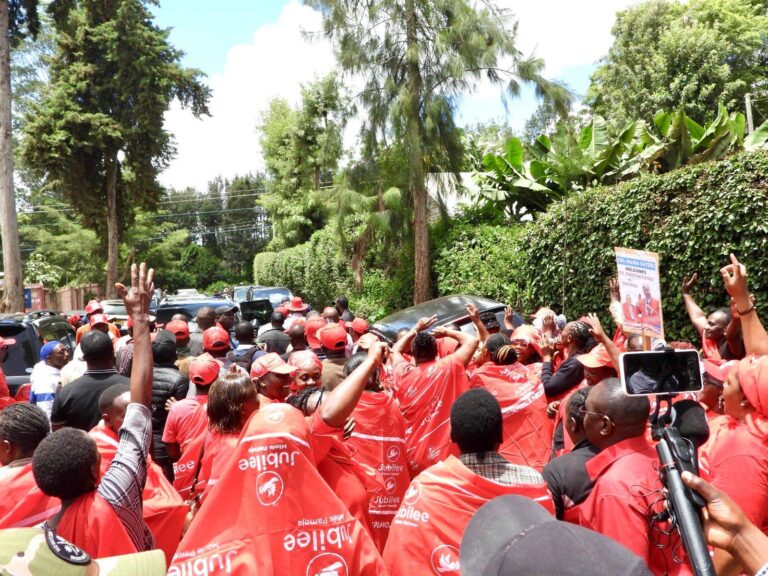
Jubilee Party today is at least 10% stronger than KANU — in numbers, in structure, and in clarity of agenda. It boasts more MPs, more influential leaders, and more active grassroots networks. It may not be what it was in 2017, but compared to KANU, Jubilee still has a pulse and a presence across the country.
Now look at President William Ruto. As the sitting Head of State, KANU should be the least of his concerns. It holds no parliamentary weight, and its influence has largely faded. Yet that did not stop Ruto from reaching out to Gideon Moi and signing a working agreement with KANU — because in politics, numbers and networks matter, no matter how small. That is what mature leadership looks like: strategic inclusion, not petty exclusion.
Contrast that with Rigathi Gachagua. Here is an impeached politician leading a shell of a party that has never won a single elective seat — not even a cattle dip chairmanship — yet he dismisses Jubilee as a “red wheelbarrow,” mocks its existence, and calls for its dissolution. Instead of uniting the opposition or broadening alliances, he isolates potential allies and shrinks the space he so badly needs to survive politically.
If Ruto, at the height of power, can humble himself to build bridges with smaller parties like KANU, who is Gachagua to reject Jubilee? Leadership is not about ego or slogans — it is about coalition-building and pragmatism.
And yet, there are those who still imagine Ruto could lose to a faction led by Gachagua. Alale aote tena. The mountain has seen through the noise — and knows the difference between strategy and desperation.